Showing posts with label books. Show all posts
Showing posts with label books. Show all posts
Wednesday, July 04, 2012
Hellfire reloaded
And here they came. I knew there was something wrong with not sweating like hell at 30 degrees on a bike. Today, the last 500 metres, I was dripping. The last 500 metres is basically 5 minutes up a hill.
The reason why is because today there was a carrotmob in Linz in 7 shops. So I bought two pairs of linen trousers for my vacation in Japan (30 degrees will be heaven over there), some foodstuff and borrowed, ahem, 10 books from the library. Thus I had some additional weight on me. Nevertheless, I was full of endorphines from the nice carrotmob-shops (and the books!). They all offered free carrot cake :D

Thursday, March 04, 2010
Spring, spring, spring
Watched Sherlock Holmes. I didn't expect any similarities to the original Sherlock, so I wasn't disappointed. It's a neat film. I enjoyed it.
A lot was changed in comparision with the original books. I'm not a die-hard detective novel fan, so I don't mind. It makes me wonder why, though. There isn't much left of what Sherlock was in the 19th century. You still have the deductive intellect and the affinity to the night. But, also, now you have sex and action.
My theories are that either people don't like a perfect hero anymore, because they cannot relate to them. Sherlock is pretty much perfect, when it comes to the standards of the time in which he was written. Dr. Watson's role was also spiced up. There's no top-down hierarchy anymore. Instead, you have a flat hierarchy. What does that tell us? The western world still has mostly top-down hierarchies, and I don't think most people want to change it (do I hear yells of "anarchy!"?).
Maybe a pure detective movie wouldn't work anymore. Not enough action. Nothing to get women into the theatres.
Who knows?
***
Now there's a video game on guerilla gardening. You can see pretty neat stuff on this video. Screaming flowers. And there will be puppies.
I swear, Subterranean Press publishes the prettiest books (probably also the most expensive ones). Now there's a limited edition of Neil Gaiman's Neverwhere. Awesome book. Pretty, pretty edition.
(But why does the market practically force consumers to have a credit card to acquire all the neat things?)
***
Some tiny illustrations I did for work:


There's a colored version of the latter somewhere...
A lot was changed in comparision with the original books. I'm not a die-hard detective novel fan, so I don't mind. It makes me wonder why, though. There isn't much left of what Sherlock was in the 19th century. You still have the deductive intellect and the affinity to the night. But, also, now you have sex and action.
My theories are that either people don't like a perfect hero anymore, because they cannot relate to them. Sherlock is pretty much perfect, when it comes to the standards of the time in which he was written. Dr. Watson's role was also spiced up. There's no top-down hierarchy anymore. Instead, you have a flat hierarchy. What does that tell us? The western world still has mostly top-down hierarchies, and I don't think most people want to change it (do I hear yells of "anarchy!"?).
Maybe a pure detective movie wouldn't work anymore. Not enough action. Nothing to get women into the theatres.
Who knows?
***
Now there's a video game on guerilla gardening. You can see pretty neat stuff on this video. Screaming flowers. And there will be puppies.
I swear, Subterranean Press publishes the prettiest books (probably also the most expensive ones). Now there's a limited edition of Neil Gaiman's Neverwhere. Awesome book. Pretty, pretty edition.
(But why does the market practically force consumers to have a credit card to acquire all the neat things?)
***
Some tiny illustrations I did for work:


There's a colored version of the latter somewhere...
Wednesday, January 06, 2010
The Visual and the Lexical
Some interesting points concerning my diploma thesis topic from the PhD thesis of A. Hall (The Meaning of Elf and Elves in Medieval England):
- Looking at the linguistic treatment of the word "aelf", they are not small and invisible
- Elves have sometimes been related to (fallen) angels. If you leave aside the "fallen" part, elves are related to holiness. This explains why Thomas Hardy, in Jude the Obsucre, compares the female main character twice with an elf or calls her elfin - thus stressing her purity.
- In the 8th century, aelf still connotated males only. It wasn't until the 11th century that the term could also denote females.
***
The cinemas in Linz seem to be overrun because a. it's vacation time and b. Avatar is on. It's seriously impossible to reserve a seat at the evening screenings, unless you want to sit in the first four rows. Despite this, I managed to see it (in the afternoon).
Avatar is awesome. I love it. Finally, after probably a year of bad films, one worth watching (except for Up and District 9, maybe). The creature design is so-so (in general, it's pretty obvious where the film drew its inspirations from, starting with the overall story down to most creature designs). The birds are neat. So are the winged frogs and the avatars/Na'vi. Most impressive of all is the landscape design. The beauty, colourfulness and richness of the plant life is sheer overwhelming (which is probably good and necessary, if you think about the gist of the story). The cinematography was good, too. I likefd how depth and perspective were used and played with, especially in the intitial sequence. That made the 3D effect even more impressive. Later it was used in a more subdued way, which I think I prefer when it comes to 3D. It just makes you feel at home with the technology, because it seems natural. When the technology is shoved into your face, it rather screams "Look at me. See how cool I am. The special effects are all you need to pay attention to. Ignore everything else."
The acting was very convincing. Sam Worthington and Sigourney Weaver did an outstanding job both as humans and in their avatars. Cameron has created a bunch of very likable characters (I'm thinking particularly of Trudy here).
-Minor spoiler warning. Don't read on if you haven't seen the film yet-
The story - yes, it was predictable and has been there before (multiple times). Does it matter? I think not. Most stories have parallels to stories that have been here before, because, well, we're all human and pretty much the same stuff makes us all tick. We write stories that we'd want to read ourselves, so it's clear that they have certain common denominators. The message of Avatar is an important one, and it hurts not to have it repeated.
For me, the film reminded me that I have wanted to read into various indigenous cultures for some time (too much stuff I want to read). Their culture, their belief system, their rites, and, most importantly, their place in today's globalised world. And not just the major, known ones, like the Native Americans or Aboriginees. Like with languages, there's a multitude of cultures out there which are dying every moment. I can only imagine the knowledge and individuality that has been lost in this process. To learn about and listen to them is, I believe, an enriching journey.
***
An awesome video of Eiga doing oji waza. My eyes are getting watery when I watch this.
Mit dem neuen Jahr kommt auch eine neue Ausgabe des vierteljährlich erscheinenden Fanzines für Spekulative Fiktion (Fantasy/SciFi/Horror/Mystery) Specflash. 90 Seiten an Kurzgeschichten, Interviews, Artikeln und Rezensionen laden zum Lesen ein. Das Hauptthema der Ausgabe sind Vampire. Empfehlenswert ist vor allem Udo Eickenbergs Kurzgeschichte "Die letzte Prüfung", die auf die Entwicklung der Menschheit in den nächsten 150 Jahren blickt.
Ich koche ja gerne und oft, und probiere fast täglich neue Rezepte aus. Bei der Rezeptsuche und beim Foren-Lesen kommt man dabei stets über das beliebte Wort "lecker". Mittlerweile kann ich's nicht mehr sehen. So geht es wohl nicht nur mir, denn beim Stöbern in einem ausgezeichneten Koch-Blog, kam ich über diesen Eintrag. Viel Spaß beim Lexikon-Erweitern!
- Looking at the linguistic treatment of the word "aelf", they are not small and invisible
- Elves have sometimes been related to (fallen) angels. If you leave aside the "fallen" part, elves are related to holiness. This explains why Thomas Hardy, in Jude the Obsucre, compares the female main character twice with an elf or calls her elfin - thus stressing her purity.
- In the 8th century, aelf still connotated males only. It wasn't until the 11th century that the term could also denote females.
***
The cinemas in Linz seem to be overrun because a. it's vacation time and b. Avatar is on. It's seriously impossible to reserve a seat at the evening screenings, unless you want to sit in the first four rows. Despite this, I managed to see it (in the afternoon).
Avatar is awesome. I love it. Finally, after probably a year of bad films, one worth watching (except for Up and District 9, maybe). The creature design is so-so (in general, it's pretty obvious where the film drew its inspirations from, starting with the overall story down to most creature designs). The birds are neat. So are the winged frogs and the avatars/Na'vi. Most impressive of all is the landscape design. The beauty, colourfulness and richness of the plant life is sheer overwhelming (which is probably good and necessary, if you think about the gist of the story). The cinematography was good, too. I likefd how depth and perspective were used and played with, especially in the intitial sequence. That made the 3D effect even more impressive. Later it was used in a more subdued way, which I think I prefer when it comes to 3D. It just makes you feel at home with the technology, because it seems natural. When the technology is shoved into your face, it rather screams "Look at me. See how cool I am. The special effects are all you need to pay attention to. Ignore everything else."
The acting was very convincing. Sam Worthington and Sigourney Weaver did an outstanding job both as humans and in their avatars. Cameron has created a bunch of very likable characters (I'm thinking particularly of Trudy here).
-Minor spoiler warning. Don't read on if you haven't seen the film yet-
The story - yes, it was predictable and has been there before (multiple times). Does it matter? I think not. Most stories have parallels to stories that have been here before, because, well, we're all human and pretty much the same stuff makes us all tick. We write stories that we'd want to read ourselves, so it's clear that they have certain common denominators. The message of Avatar is an important one, and it hurts not to have it repeated.
For me, the film reminded me that I have wanted to read into various indigenous cultures for some time (too much stuff I want to read). Their culture, their belief system, their rites, and, most importantly, their place in today's globalised world. And not just the major, known ones, like the Native Americans or Aboriginees. Like with languages, there's a multitude of cultures out there which are dying every moment. I can only imagine the knowledge and individuality that has been lost in this process. To learn about and listen to them is, I believe, an enriching journey.
***
An awesome video of Eiga doing oji waza. My eyes are getting watery when I watch this.
Mit dem neuen Jahr kommt auch eine neue Ausgabe des vierteljährlich erscheinenden Fanzines für Spekulative Fiktion (Fantasy/SciFi/Horror/Mystery) Specflash. 90 Seiten an Kurzgeschichten, Interviews, Artikeln und Rezensionen laden zum Lesen ein. Das Hauptthema der Ausgabe sind Vampire. Empfehlenswert ist vor allem Udo Eickenbergs Kurzgeschichte "Die letzte Prüfung", die auf die Entwicklung der Menschheit in den nächsten 150 Jahren blickt.
Ich koche ja gerne und oft, und probiere fast täglich neue Rezepte aus. Bei der Rezeptsuche und beim Foren-Lesen kommt man dabei stets über das beliebte Wort "lecker". Mittlerweile kann ich's nicht mehr sehen. So geht es wohl nicht nur mir, denn beim Stöbern in einem ausgezeichneten Koch-Blog, kam ich über diesen Eintrag. Viel Spaß beim Lexikon-Erweitern!
Wednesday, July 02, 2008
The Handmaid's Tale and Rechberg
Book recommendation: The Handmaid’s Tale by Margaret Atwood
With The Handmaid’s Tale Margarte Atwood follows the tradition of George Orwell’s 1984 by drawing up the picture of an alternative, dystopian present. The novel’s reality is based on a well-controlled patriarchate in which women are put into a position that is reminiscent of the nineteenth century. “Families” consist, if they are lucky, of a husband and a wife, between who there is often no love lost, and a Handmaid, whose job it is to get pregnant, give birth to a child and then to be referred to the next family.
The protagonist of the novel is one of these Handmaids and tells her version of the time before society changed and how she now lives after the change. While rather little actually happens in the novel, the reader’s interest is kept throughout the 280 pages by the glimpses that Atwood gives us about “her” society. We learn about its rules, people’s resistance and find enjoyment in discovering similarities to religious dogmas and society as it was a century ago.
What I find fascinating about the dystopian stories that I have come across recently is their obsession with childhood and childbirth. I was strongly reminded of the film Children of Men when I read The Handmaid’s Tale. Both stories pick out childbirth, or rather the lack of it, as a central theme. It’s probably reasonable enough – after all, Science Fiction criticizes the present by showing how the future may look like if we continue as we do; and children are one of the strongest symbols for the future. No children – no future.
***
This weekend was another medieval fair, this time in Rechberg. The promotion already started a week before the event, on Monday, when the band Rhiannon began a trip on foot from Linz to Rechberg (60km) in four days, accompanied by a baker with his donkey, the Tuchfärberey. Which is an endeavour that, in my eyes, absolutely rocks.
The market itself was wonderful. Situated in the middle of Mother Nature, very large and friendly. The music seemed to be more of the quiet kind, which is rare on markets, as the bands usually need to gather attention. I enjoyed the more peaceful music a lot.
Unfortunately the market only takes place once every two years, and it isn’t sure if it will be the same next time, which is a shame. I could have spent days there (Sunday alone went by too fast and simply wasn’t enough).

The beginning of the trip on Monday in Linz.

Some of the musicians played additionally apart from the announced program. Here's the new band member of Rhiannon with her harp.

We squeezed in a little photo session on one of the sidetracks that led from one area to another. (Her smile is actually nervous. "Wellll. I'm sitting on a slippery, moss-covered stone and at some point I need to get off again.")

"Now I'll freeze like that, become a statue, then I won't have to get off at all."
(Medieval leather-shoes are actually very tough for walking and climbing around like that. Christine rescued me several times from fallling very hard.)

20.000 shades of green.

A highlight of the fair. This German Spitz was the most hyperactive dog I've ever seen. In a cute "Give me attention! I wanna play! I'm here! Look at me!" sort of way. And whenever he got the attention of his owner he happily freaked out :D

After the end of the fair Christine and I went to the near observation tower in the forest.
I'm biased, but I think the Mühlviertel has some of the most beautiful landscapes in Austria. Forest, hills, all very soft and round and green.

And became queens of the world for some odd minutes (Well, she did. I was much too concerned by the suspicious noises the wood of the tower made whenever we moved).

Not quite an adventurous pirate lass, but maybe at some point in the future...
With The Handmaid’s Tale Margarte Atwood follows the tradition of George Orwell’s 1984 by drawing up the picture of an alternative, dystopian present. The novel’s reality is based on a well-controlled patriarchate in which women are put into a position that is reminiscent of the nineteenth century. “Families” consist, if they are lucky, of a husband and a wife, between who there is often no love lost, and a Handmaid, whose job it is to get pregnant, give birth to a child and then to be referred to the next family.
The protagonist of the novel is one of these Handmaids and tells her version of the time before society changed and how she now lives after the change. While rather little actually happens in the novel, the reader’s interest is kept throughout the 280 pages by the glimpses that Atwood gives us about “her” society. We learn about its rules, people’s resistance and find enjoyment in discovering similarities to religious dogmas and society as it was a century ago.
What I find fascinating about the dystopian stories that I have come across recently is their obsession with childhood and childbirth. I was strongly reminded of the film Children of Men when I read The Handmaid’s Tale. Both stories pick out childbirth, or rather the lack of it, as a central theme. It’s probably reasonable enough – after all, Science Fiction criticizes the present by showing how the future may look like if we continue as we do; and children are one of the strongest symbols for the future. No children – no future.
***
This weekend was another medieval fair, this time in Rechberg. The promotion already started a week before the event, on Monday, when the band Rhiannon began a trip on foot from Linz to Rechberg (60km) in four days, accompanied by a baker with his donkey, the Tuchfärberey. Which is an endeavour that, in my eyes, absolutely rocks.
The market itself was wonderful. Situated in the middle of Mother Nature, very large and friendly. The music seemed to be more of the quiet kind, which is rare on markets, as the bands usually need to gather attention. I enjoyed the more peaceful music a lot.
Unfortunately the market only takes place once every two years, and it isn’t sure if it will be the same next time, which is a shame. I could have spent days there (Sunday alone went by too fast and simply wasn’t enough).

The beginning of the trip on Monday in Linz.

Some of the musicians played additionally apart from the announced program. Here's the new band member of Rhiannon with her harp.

We squeezed in a little photo session on one of the sidetracks that led from one area to another. (Her smile is actually nervous. "Wellll. I'm sitting on a slippery, moss-covered stone and at some point I need to get off again.")

"Now I'll freeze like that, become a statue, then I won't have to get off at all."
(Medieval leather-shoes are actually very tough for walking and climbing around like that. Christine rescued me several times from fallling very hard.)

20.000 shades of green.

A highlight of the fair. This German Spitz was the most hyperactive dog I've ever seen. In a cute "Give me attention! I wanna play! I'm here! Look at me!" sort of way. And whenever he got the attention of his owner he happily freaked out :D

After the end of the fair Christine and I went to the near observation tower in the forest.
I'm biased, but I think the Mühlviertel has some of the most beautiful landscapes in Austria. Forest, hills, all very soft and round and green.

And became queens of the world for some odd minutes (Well, she did. I was much too concerned by the suspicious noises the wood of the tower made whenever we moved).

Not quite an adventurous pirate lass, but maybe at some point in the future...
Thursday, January 31, 2008
Something remarkable
He says my daugther, and all the love he has is wrapped up in the tone of his voice when he says those two words, he says my daugther you must always look with both of your eyes and listen with both of your ears. He says this is a very big world and there are many many things you could miss if you are not careful. He says there are remarkable things all the time, right in front of us, but our eyes have like the clouds over the sun and our lives are paler and poorer if we do not see them for what they are.
He says, if nobody speaks of remarkable things, how can they be called remarkable?
- Jon McGregor, "if nobody speaks of remarkable things"
He says, if nobody speaks of remarkable things, how can they be called remarkable?
- Jon McGregor, "if nobody speaks of remarkable things"
Monday, November 26, 2007
Many Meetings
Had a nicely busy last week. I'm starting to like these weekends when I'm up and about every day. Time seems to move slower then, and you experience much more.
But first, books I finished and liked.
Humphrey Carpenter - J. R. R. Tolkien, A Biography
Biographies usually don't appeal to me too much. Recently I've been enjoying them, though. You learn a lot about other people's dreams and ideas. Carpenter moves chronologically through the stages of Tolkien's life, from South Africa through the war to Oxford and Tolkien's last years in South England. If you've read the Lord of the Rings, Tolkien's biography is a small treasure chest. It made me realize that all of Tolkien's life echoes in his works (especially in LotR). Every inch of the way the Fellowship travels is an inch on the way of Tolkien's life. I find this quite amazing.
Reading about all the experiences Tolkien had in his early life was also very interesting. It's a bit intimidating to know about all the languages he taught himself even before going to University and the depth of his love for language. Then his experiences in the World War - a very short chapter, but nevertheless very shocking, especially since the book contains letters from Tolkien and his friends which reflect their feelings more authentically than a simple report could. You get a tiny sense of how crushed he must have been when he lost almost all of his close friends to the war. We probably can't even begin to imagine the full extent of what people felt during the wars. Lucky us.
Tolkien must have been a brilliant man. He had his failings (incidentally, they are sometimes described as his strengths ... shows you how subjective certain things are) and made mistakes, but it seems he usually acted with the best intent and purely out of love for his passions - an attitude that is quite inspirational. Maybe that's what biographies are for; to inspire you and give you an idea of how much can be achieved in a lifetime.
Peter S. Beagle - Tamsin
My sentiments towards Peter S. Beagle are a bit split. Watching the Last Unicorn has become a personal Christmas tradition through the years (even now that I have it on DVD and don't have to wait for December 24th to see it on TV). I probably love the film more than any other animation, simply for its underlying concepts that are hinted at, but not told, and for the ideas these concepts gave me in my childhood. And Christopher Lee's voice as King Haggard is simply wonderful.
The book, however, and other books I'd read so far by Peter S. Beagle, is a different matter. I could never fully take to the writing style. The thing I liked most about it was that it explained some of the concepts the film had hinted at further. But my heart was always with the film, not with the book. Beagle got a second chance when I read The Innkeeper's Song, which was even worse (stylistically). Good story, ideas and concepts, but the style made it very tedious for me. Then I tried his short story collection, The Line Between, of which I remember absolutely nothing.
Still, I didn't give up at that point. I just loved the film too much, and this made me want to love the author and his other books, too. So I let some months pass and gave it a fourth try. Fourth time's the charm, eh?
Tamsin tells the story of a girl, Jenny, who is forced to move from America to England upon her mother's second marriage. The family moves to a rural area into a farm house. Here Jenny begins to see the ghost of a girl, Tamsin, who she befriends. And slowly the story on the history of the farm, Tamsin's life and death and Jenny's coping with her new surroundings and family unravel.
It's the strong voice of the protagonist that made this book so appealing. From the beginning her teenage emotions draw you in and carry you through the story - from the sulkiness due to the unfairness of life up to the utter and overwhelming curiosity she displays at everything and everyone in the world, so you begin to share her interest in the farm and its history. I guess this shows you again how important appealing protagonists are (at least for me). They can kill the story or bring it to life.
Fourth chances are good. You just need to search for long enough and at some point it will click. I only needed to go through four average books to get to a sweet one ("sweet" is probably the right category. I assume the target group are children and teenagers, but I can easily enjoy it even though I'm slightly older ;)
***
That's it concerning books for now. On to last week's business. There was a conference on Popular Culture vs. High Culture in Salzburg from Thursday to Saturday, which I attended on Thursday afternoon and Friday morning. Special guest was John Storey, professor of cultural studies. He specialises, among other things, in popular culture, identity, consumption and globalisation. In my Pop Culture lecture in Oxford three years ago we read one of his books (I still remember most of what he wrote in it, which tells you how accessible he can make his research topics).
It was my first conference and I enjoyed it thoroughly. The topics were great. John Storey talked about the concepts of pop and high culture; another talk was on Doctor Who and its intertextuality and relation to British Culture (comparisions with Buffy, the Vampire Slayer were thrown in occasionally), and my favourite talk was on TV Judges and the Law. The talk analysed the success of courtroom shows. In one of my lecture we had discussed talkshows and their aims the week before, so I constantly compared the talkshows with the court shows. Basically, it was said that talkshows aim at establishing borders and boundaries for social behaviour. They are manufacture for consensus (Konsensmanufakturen), shown by the fact that according to surveys most of the audience (in the studio and in front of the TV) is under the impression that the show host "always agrees with me". People don't primarily watch talkshows to make fun of people's behaviour, but to be told which behaviour is acceptable and which isn't. The host is the one who established these boundaries - if one of the guests breaks through the boundaries that the show aims at building, s/he gets sent off the stage (sometimes even without applause, which tells the audience that his behaviour was utterly inacceptable and out of the norm).
In court shows, not the host but the law sets the boundaries. So in the end court shows aim at reassuring the audience that the country's law system works and is reliable. Unlike talkshows, court shows don't work in all countries, because the court system is very different in some parts. British audience never took a liking to the court shows, so they are virtually unknown in Britain. Allegedly the reason for this is that the law is always portrayed negatively on regular TV (in films, series, etc.), so the British audience rejects a TV format that is affirmative towards the law. Quite fascinating. I wonder what this tells you about the countries that broadcast court shows successfully. It seems we need (or are pressured to find) reassurance in everything - social behavour through talkshows, the law through court shows. What's next? People used to live by trial and error and the experiences of their elders for centuries, but now we need how-to's, workshops and TV shows for everything.
***
Friday afternoon/evening and Saturday was spent in Innsbruck, practicing Kendo, meeting many new people, learning lots and having tons of fun. Warm-ups with 18 people are just great. There's so much more energy present right from the beginning.
Sunday went by with moving stuff from Salzburg to Linz ... not fun. You realize how much stuff you've accumulated when you need to move. And the next time I move there'll be even more stuff to take care of (e.g. all the stuff that's towering up left and right of me and that I have to step over at the moment when I want to walk through my room).
And now it's snowtime! By far not as beautiful as the awesome view we had in Innsbruck on Saturday morning from our sleepingplace (somewhere between mountains, mountains and rocks), but nevertheless I love the sight of the first significant snow on Linz.


But first, books I finished and liked.
Humphrey Carpenter - J. R. R. Tolkien, A Biography
Biographies usually don't appeal to me too much. Recently I've been enjoying them, though. You learn a lot about other people's dreams and ideas. Carpenter moves chronologically through the stages of Tolkien's life, from South Africa through the war to Oxford and Tolkien's last years in South England. If you've read the Lord of the Rings, Tolkien's biography is a small treasure chest. It made me realize that all of Tolkien's life echoes in his works (especially in LotR). Every inch of the way the Fellowship travels is an inch on the way of Tolkien's life. I find this quite amazing.
Reading about all the experiences Tolkien had in his early life was also very interesting. It's a bit intimidating to know about all the languages he taught himself even before going to University and the depth of his love for language. Then his experiences in the World War - a very short chapter, but nevertheless very shocking, especially since the book contains letters from Tolkien and his friends which reflect their feelings more authentically than a simple report could. You get a tiny sense of how crushed he must have been when he lost almost all of his close friends to the war. We probably can't even begin to imagine the full extent of what people felt during the wars. Lucky us.
Tolkien must have been a brilliant man. He had his failings (incidentally, they are sometimes described as his strengths ... shows you how subjective certain things are) and made mistakes, but it seems he usually acted with the best intent and purely out of love for his passions - an attitude that is quite inspirational. Maybe that's what biographies are for; to inspire you and give you an idea of how much can be achieved in a lifetime.
Peter S. Beagle - Tamsin
My sentiments towards Peter S. Beagle are a bit split. Watching the Last Unicorn has become a personal Christmas tradition through the years (even now that I have it on DVD and don't have to wait for December 24th to see it on TV). I probably love the film more than any other animation, simply for its underlying concepts that are hinted at, but not told, and for the ideas these concepts gave me in my childhood. And Christopher Lee's voice as King Haggard is simply wonderful.
The book, however, and other books I'd read so far by Peter S. Beagle, is a different matter. I could never fully take to the writing style. The thing I liked most about it was that it explained some of the concepts the film had hinted at further. But my heart was always with the film, not with the book. Beagle got a second chance when I read The Innkeeper's Song, which was even worse (stylistically). Good story, ideas and concepts, but the style made it very tedious for me. Then I tried his short story collection, The Line Between, of which I remember absolutely nothing.
Still, I didn't give up at that point. I just loved the film too much, and this made me want to love the author and his other books, too. So I let some months pass and gave it a fourth try. Fourth time's the charm, eh?
Tamsin tells the story of a girl, Jenny, who is forced to move from America to England upon her mother's second marriage. The family moves to a rural area into a farm house. Here Jenny begins to see the ghost of a girl, Tamsin, who she befriends. And slowly the story on the history of the farm, Tamsin's life and death and Jenny's coping with her new surroundings and family unravel.
It's the strong voice of the protagonist that made this book so appealing. From the beginning her teenage emotions draw you in and carry you through the story - from the sulkiness due to the unfairness of life up to the utter and overwhelming curiosity she displays at everything and everyone in the world, so you begin to share her interest in the farm and its history. I guess this shows you again how important appealing protagonists are (at least for me). They can kill the story or bring it to life.
Fourth chances are good. You just need to search for long enough and at some point it will click. I only needed to go through four average books to get to a sweet one ("sweet" is probably the right category. I assume the target group are children and teenagers, but I can easily enjoy it even though I'm slightly older ;)
***
That's it concerning books for now. On to last week's business. There was a conference on Popular Culture vs. High Culture in Salzburg from Thursday to Saturday, which I attended on Thursday afternoon and Friday morning. Special guest was John Storey, professor of cultural studies. He specialises, among other things, in popular culture, identity, consumption and globalisation. In my Pop Culture lecture in Oxford three years ago we read one of his books (I still remember most of what he wrote in it, which tells you how accessible he can make his research topics).
It was my first conference and I enjoyed it thoroughly. The topics were great. John Storey talked about the concepts of pop and high culture; another talk was on Doctor Who and its intertextuality and relation to British Culture (comparisions with Buffy, the Vampire Slayer were thrown in occasionally), and my favourite talk was on TV Judges and the Law. The talk analysed the success of courtroom shows. In one of my lecture we had discussed talkshows and their aims the week before, so I constantly compared the talkshows with the court shows. Basically, it was said that talkshows aim at establishing borders and boundaries for social behaviour. They are manufacture for consensus (Konsensmanufakturen), shown by the fact that according to surveys most of the audience (in the studio and in front of the TV) is under the impression that the show host "always agrees with me". People don't primarily watch talkshows to make fun of people's behaviour, but to be told which behaviour is acceptable and which isn't. The host is the one who established these boundaries - if one of the guests breaks through the boundaries that the show aims at building, s/he gets sent off the stage (sometimes even without applause, which tells the audience that his behaviour was utterly inacceptable and out of the norm).
In court shows, not the host but the law sets the boundaries. So in the end court shows aim at reassuring the audience that the country's law system works and is reliable. Unlike talkshows, court shows don't work in all countries, because the court system is very different in some parts. British audience never took a liking to the court shows, so they are virtually unknown in Britain. Allegedly the reason for this is that the law is always portrayed negatively on regular TV (in films, series, etc.), so the British audience rejects a TV format that is affirmative towards the law. Quite fascinating. I wonder what this tells you about the countries that broadcast court shows successfully. It seems we need (or are pressured to find) reassurance in everything - social behavour through talkshows, the law through court shows. What's next? People used to live by trial and error and the experiences of their elders for centuries, but now we need how-to's, workshops and TV shows for everything.
***
Friday afternoon/evening and Saturday was spent in Innsbruck, practicing Kendo, meeting many new people, learning lots and having tons of fun. Warm-ups with 18 people are just great. There's so much more energy present right from the beginning.
Sunday went by with moving stuff from Salzburg to Linz ... not fun. You realize how much stuff you've accumulated when you need to move. And the next time I move there'll be even more stuff to take care of (e.g. all the stuff that's towering up left and right of me and that I have to step over at the moment when I want to walk through my room).
And now it's snowtime! By far not as beautiful as the awesome view we had in Innsbruck on Saturday morning from our sleepingplace (somewhere between mountains, mountains and rocks), but nevertheless I love the sight of the first significant snow on Linz.


Tuesday, October 02, 2007
Slaughtering Stories
If one-and-a-half chicken produce one-and-a-half eggs in one-and-a-half days, how many eggs do nine chicken produce in nine days?
Many months ago I saw I, Robot on TV and liked it enough to eventually buy the book, which I finished reading yesterday. Plot-wise, it was probably the most surprising book I have ever read. If you have a film fashioned after a book, you expect them to have roughly the same plot (with many cuts and edits, granted, but essentially similar). This is not the case here. What I, Robot the film and I, Robot the book have in common are an Earth that has managed to manufacture robots and the three Laws of Robotics - nothing else. My distant memory of the film tells me its plot was altogether different to what I have just finished reading.
Which is unexpected, surprising, but not necessarily bad. (It means you definitely get more plot than you could ever have expected.)
Isaac Asimov's novel is different to the books I usually read, because it does not build up suspense through character interaction and character development, which are my main interests. I normally find it hard to enjoy a novel if it has no appealing characters. That's probably why I don't read so much Hard Science Fiction - it often evolves more about the future scenario than about single people (here is, to my understanding, the essential difference between Fantasy and SciFi; Fantasy uses a world's destiny and future to build up a story around people, and SciFi uses people to visualise a possible future of our world). Surprisingly enough, I enjoyed I, Robot nevertheless and read through it quite quickly. It's a bit like a short story collection on a common theme and tells about the different stages of robot "evolution" on Asimov's Earth. It's interesting to read about these Laws of Robotics that Asimov invented and at the same time (/in the same book) he pointed out the mistakes and possible fallacies in them; an exemplary thought experiment.
***
Plot discrepancies till the end weren't the only surprise yesterday. I read that Hayao Miyazaki is a feminist, which is a term I'd never have associated with him. I guess it makes sense - the strong female characters are distinctive for his films. Still, I wouldn't have classfied the working women in Mononoke Hime as a sign for feminism; rather as an analogy to the women who had to work during war times - that's probably part of what you miss out on when you watch films from a different culture; you tend to put the situations in them into your own mindframe. Makes me wonder how many more layers foreign films have that I have no access to.
***
Lastly, I came across a great song by the comedy act Tripod. Both their song and their website make my geek heart beat a bit louder.
(Ghost Ship is quite good, too.)
***
Sketches for poses, movements, (weird) anatomy, etc.:

Many months ago I saw I, Robot on TV and liked it enough to eventually buy the book, which I finished reading yesterday. Plot-wise, it was probably the most surprising book I have ever read. If you have a film fashioned after a book, you expect them to have roughly the same plot (with many cuts and edits, granted, but essentially similar). This is not the case here. What I, Robot the film and I, Robot the book have in common are an Earth that has managed to manufacture robots and the three Laws of Robotics - nothing else. My distant memory of the film tells me its plot was altogether different to what I have just finished reading.
Which is unexpected, surprising, but not necessarily bad. (It means you definitely get more plot than you could ever have expected.)
Isaac Asimov's novel is different to the books I usually read, because it does not build up suspense through character interaction and character development, which are my main interests. I normally find it hard to enjoy a novel if it has no appealing characters. That's probably why I don't read so much Hard Science Fiction - it often evolves more about the future scenario than about single people (here is, to my understanding, the essential difference between Fantasy and SciFi; Fantasy uses a world's destiny and future to build up a story around people, and SciFi uses people to visualise a possible future of our world). Surprisingly enough, I enjoyed I, Robot nevertheless and read through it quite quickly. It's a bit like a short story collection on a common theme and tells about the different stages of robot "evolution" on Asimov's Earth. It's interesting to read about these Laws of Robotics that Asimov invented and at the same time (/in the same book) he pointed out the mistakes and possible fallacies in them; an exemplary thought experiment.
***
Plot discrepancies till the end weren't the only surprise yesterday. I read that Hayao Miyazaki is a feminist, which is a term I'd never have associated with him. I guess it makes sense - the strong female characters are distinctive for his films. Still, I wouldn't have classfied the working women in Mononoke Hime as a sign for feminism; rather as an analogy to the women who had to work during war times - that's probably part of what you miss out on when you watch films from a different culture; you tend to put the situations in them into your own mindframe. Makes me wonder how many more layers foreign films have that I have no access to.
***
Lastly, I came across a great song by the comedy act Tripod. Both their song and their website make my geek heart beat a bit louder.
(Ghost Ship is quite good, too.)
***
Sketches for poses, movements, (weird) anatomy, etc.:

Monday, February 19, 2007
Rite
So, Amazon did get its copies of Tad Williams' Rite, by Subterranean Press, and shortly later, it gave one to me. Since the book is a short story collection, I had intended to read it in pieces. Instead, it turned out, I rather gulped it down it big chunks - and how delicious it was!
It is really a beautiful book. Nice, cloth-bound hardcover (although I like the image of the protective cover quite a lot) and an illustration that goes with every short story. The illustrations are beautiful, too, black-and-white drawings (ink, I suppose) of which I like the compositions best. Anatomy and everything else it top-notch, too, but it's really the composition and the little details that made me look at every illustration twice (or thrice, or ...). The stories themselves are a pleasure to read, as well. Probably more down-to-earth than Tad Williams' novels (read: more bordering on the SF and F genre than delving straight into the middle of it), and also more humorous. I like it. It is rare that I find a short story collection that I like throughout, but with this book, this is the case. There's something I can get out of every story. It was comforting to find out that there are other people in the world who are somewhat uncomfortable using planes and revisiting Otherland was a joy, as well.
There are a few printing errors (e.g. italicized v's are barely visible), but I didn't mind them that much. The v's were actually intriguing, and at first I wasn't even sure if it was intentional or not. I can imagine a book having a letter that's not used very often in its title (in some special rendition, like the v's) and have that letter, when it crops up in the stories, look like the cover-letter. It could look nice and give the book a special touch, I think.
All in all, Rite is a book well worth reading. The fact that SP already ran out of copies should prove this, too.
***
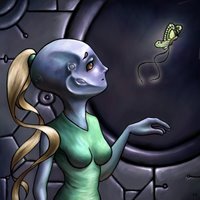
Little butterfly,
won't you come and sit with me for a while?
I will tell you about loneliness,
and you will show me how to make it go away.
Of course, little butterfly is not coming. He is flying away, because that is what pretty butterflies do when they have had enough of your garden. And she does not even have a garden, so there is nothing for him to find here.
It's a bit of a style experiment, this one. Trying to learn to do lineart. Every ten months I get a bit crazy and do a manga picture, so this is it for a while then. I have no idea how you're supposed to colorize it properly; didn't know how to paint a mouth like that (so I, err, just didn't, as you can see). I prefer semi-realism, that seems a bit easier.
So have a little preview of a proper illustration I'm working on right now:
It is really a beautiful book. Nice, cloth-bound hardcover (although I like the image of the protective cover quite a lot) and an illustration that goes with every short story. The illustrations are beautiful, too, black-and-white drawings (ink, I suppose) of which I like the compositions best. Anatomy and everything else it top-notch, too, but it's really the composition and the little details that made me look at every illustration twice (or thrice, or ...). The stories themselves are a pleasure to read, as well. Probably more down-to-earth than Tad Williams' novels (read: more bordering on the SF and F genre than delving straight into the middle of it), and also more humorous. I like it. It is rare that I find a short story collection that I like throughout, but with this book, this is the case. There's something I can get out of every story. It was comforting to find out that there are other people in the world who are somewhat uncomfortable using planes and revisiting Otherland was a joy, as well.
There are a few printing errors (e.g. italicized v's are barely visible), but I didn't mind them that much. The v's were actually intriguing, and at first I wasn't even sure if it was intentional or not. I can imagine a book having a letter that's not used very often in its title (in some special rendition, like the v's) and have that letter, when it crops up in the stories, look like the cover-letter. It could look nice and give the book a special touch, I think.
All in all, Rite is a book well worth reading. The fact that SP already ran out of copies should prove this, too.
***
Come Hither

Little butterfly,
won't you come and sit with me for a while?
I will tell you about loneliness,
and you will show me how to make it go away.
Of course, little butterfly is not coming. He is flying away, because that is what pretty butterflies do when they have had enough of your garden. And she does not even have a garden, so there is nothing for him to find here.
It's a bit of a style experiment, this one. Trying to learn to do lineart. Every ten months I get a bit crazy and do a manga picture, so this is it for a while then. I have no idea how you're supposed to colorize it properly; didn't know how to paint a mouth like that (so I, err, just didn't, as you can see). I prefer semi-realism, that seems a bit easier.
So have a little preview of a proper illustration I'm working on right now:

Monday, November 13, 2006
Books
I think I've spoken about this before. My brother cleaned part of his flat during summer (Until I started to help him and Christine by throwing everything out of the cupboards onto the floor, and Christine yelled at me because she couldn't keep up with throwing/putting the stuff on the floor away. Then I didn't have time anymore to help and they stopped cleaning up, too.). During that time I ravaged the whole flat for books that sounded interesting enough to give them a try.
So now I have a cupboard full of unread books. I started reading last week.
A great part of these books are 'Reader's Digest', collections of classics and bestsellers. I was always wary of those, because they look like they're boring classics that everybody should know, and therefore are collected in these digests (so people can buy them to at least pretend they know the stories).
Well, surprise, I like half of the book I've read so far. That is, I've read 2/3 or 1/2 of Benchley's White Shark (like most stories in the Reader's Digest, it's abridged - so 1/3 or 1/2 has been abridged away and I can't read it) in a day. Gore, missing limbs, and a love story. The heart of every bestseller. I liked it enough to wonder what's written in the missing parts of the book. I'm guessing it's the adultery part and lovestory.
Next were short stories by Ephraim Kishon, who apparently writes satire. I read those on the train, smiling and chuckling. Some of them are very good and insightful (concerning society and humanity), others are predictable. They made me want to read more of Kishon.
Last story of today, the one I only started reading, is Richard Martin Stern's 'The Tower'. I'm intrigued by it. It was written in 1973 and is about a recently finished huge tower in New York. During the opening ceremony a suicide bomber causes havoc. I believe there'll be a fire and lots of dead people, but I haven't read that far yet. The World Trade Center gets mentioned several times in the first few pages. One sentence startled me a bit, at the end of chapter 3 (rough translation): "In a world, in which violence seemed to be the norm, sabotaging a building was anything but unthinkable." 1973.
According to the introduction, Stern wanted to warn people of catastrophes. Shortly before the story was published 50 people died in a fire in a themepark, and some months later 200 died in a fire in an office skyscraper. Still, people want to build higher and higher, and only recently the newspapers published a planned project in Dubai, where some mad millionaire wants to build the highest skyscraper on earth (if I had ever read the Bible I'd probably reference Bablyon now; instead, I'll just do some elegant Babylon-namedropping and pretend I know what I'm talking about. Lalala.).
So now I have a cupboard full of unread books. I started reading last week.
A great part of these books are 'Reader's Digest', collections of classics and bestsellers. I was always wary of those, because they look like they're boring classics that everybody should know, and therefore are collected in these digests (so people can buy them to at least pretend they know the stories).
Well, surprise, I like half of the book I've read so far. That is, I've read 2/3 or 1/2 of Benchley's White Shark (like most stories in the Reader's Digest, it's abridged - so 1/3 or 1/2 has been abridged away and I can't read it) in a day. Gore, missing limbs, and a love story. The heart of every bestseller. I liked it enough to wonder what's written in the missing parts of the book. I'm guessing it's the adultery part and lovestory.
Next were short stories by Ephraim Kishon, who apparently writes satire. I read those on the train, smiling and chuckling. Some of them are very good and insightful (concerning society and humanity), others are predictable. They made me want to read more of Kishon.
Last story of today, the one I only started reading, is Richard Martin Stern's 'The Tower'. I'm intrigued by it. It was written in 1973 and is about a recently finished huge tower in New York. During the opening ceremony a suicide bomber causes havoc. I believe there'll be a fire and lots of dead people, but I haven't read that far yet. The World Trade Center gets mentioned several times in the first few pages. One sentence startled me a bit, at the end of chapter 3 (rough translation): "In a world, in which violence seemed to be the norm, sabotaging a building was anything but unthinkable." 1973.
According to the introduction, Stern wanted to warn people of catastrophes. Shortly before the story was published 50 people died in a fire in a themepark, and some months later 200 died in a fire in an office skyscraper. Still, people want to build higher and higher, and only recently the newspapers published a planned project in Dubai, where some mad millionaire wants to build the highest skyscraper on earth (if I had ever read the Bible I'd probably reference Bablyon now; instead, I'll just do some elegant Babylon-namedropping and pretend I know what I'm talking about. Lalala.).
Subscribe to:
Posts (Atom)